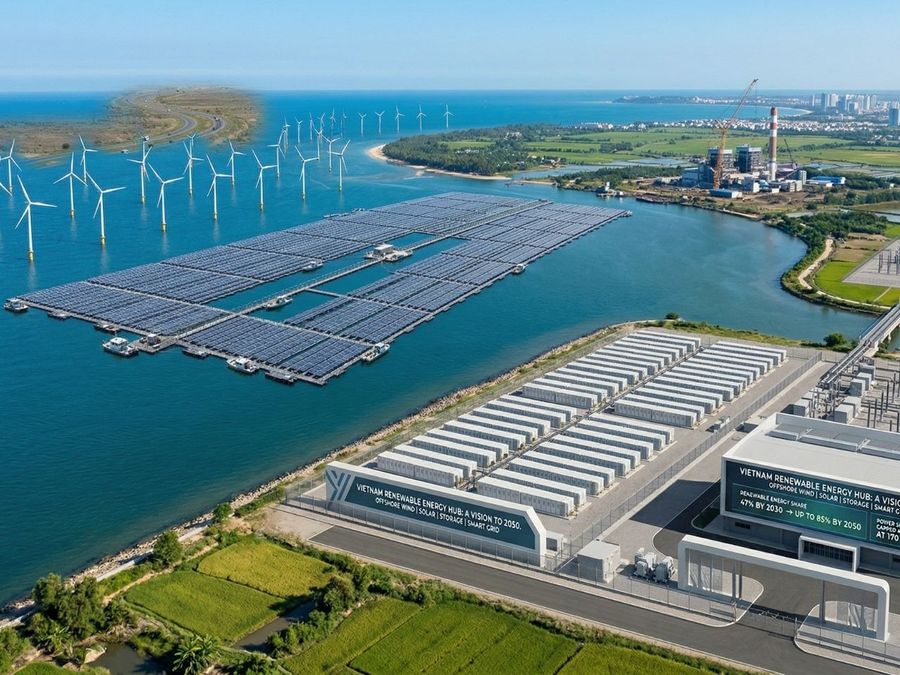
Vietnam is speeding up its green energy shift by planning two major renewable energy hubs by 2030 under a revised Just Energy Transition Partnership (JETP) roadmap. This bold move supports the country’s goal of net-zero emissions and meets rising power needs for its fast-growing economy. Deputy Prime Minister Bui Thanh Son approved the updated JETP plan on March 23, 2026. It focuses on building inter-regional hubs: one in the north, covering Hai Phong, Quang Ninh, and Thai Binh; the other in the south, creating full value chains for solar, wind, and storage. These hubs will boost manufacturing, services, and exports of clean tech.
The plan aligns with Adjusted Power Development Plan VIII (PDP VIII). By 2030, Vietnam targets 46,459-73,416 MW of solar power, 26,066-38,029 MW of onshore wind, and 6,000 MW of offshore wind. Renewables will make up 28-36% of energy output, with battery storage hitting 10,000-16,300 MW. Coal and gas will drop, cutting emissions from 240 MtCO2e to 170 MtCO2e in the power sector.
This $136 billion investment ensures energy security while drawing global funds from JETP partners like the EU and UK. It promotes smart grids, offshore wind pilots by 2030-2035, and efficient use. Vietnam’s economy, growing 6-7% yearly, will benefit from jobs in Dak Lak’s 90 projects (7,780 MW capacity) and reduced LNG imports.
FAQs [Frequently Asked Questions]
1. What are Vietnam’s renewable targets by 2030?
Solar up to 73,416 MW, onshore wind 38,029 MW, offshore wind 6,000 MW, battery storage 10,000-16,300 MW, renewables 28-36% of output.
2. Where will the two energy hubs be located?
Northern hub in Hai Phong, Quang Ninh, Thai Binh; southern hub to build similar value chains for renewables and industry.
3. How does JETP help Vietnam’s transition?
Revised plan cuts power sector emissions to 170 MtCO2e by 2030, funds grids, storage, and new renewables for net-zero goals.
(*Image Source- Saur Energy)