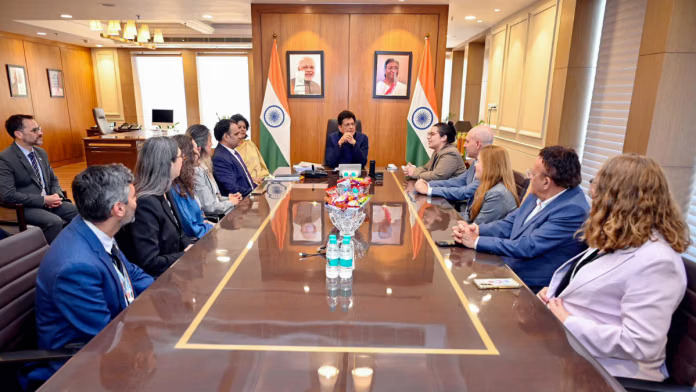
Union Minister Piyush Goyal met an Israeli delegation in New Delhi for the first round of Free Trade Agreement (FTA) negotiations, held from February 23 to 26, 2026. This marks a key step to boost bilateral trade, which reached $3.75 billion in FY25, with India’s exports at $2.1 billion and imports at $1.6 billion. The talks follow the Terms of Reference signed in November 2025 during Goyal’s Israel visit. Teams discussed trade in goods and services, rules of origin, sanitary measures, technical barriers, customs, and intellectual property rights. Israel’s chief negotiator Yifat Alon Perel noted the FTA’s potential to strengthen supply chains and open new markets. Commerce Secretary Rajesh Agrawal called it timely, aligning with PM Modi’s Israel visit on February 25-26.
India ranks as Israel’s second-largest Asian trading partner. Focus areas include innovation, AI, cybersecurity, high-tech manufacturing, agriculture, and services. The deal avoids sensitive sectors like dairy or rice, emphasizing strategic ties in defense, semiconductors, and agritech. Experts predict diversification from diamonds and chemicals to electronics and medical devices.
Bilateral investments total around $800 million, with Israel investing $334 million in India. The FTA aims to cut tariffs, simplify processes, and enhance cooperation amid regional challenges. Goyal stressed opportunities for businesses and people on both sides.
FAQs [Frequently Asked Questions]
1. When did the first round of India-Israel FTA talks start?
The first round began on February 23, 2026, in New Delhi and runs until February 26, following ToR signed in November 2025.
2. What is the current India-Israel trade volume?
Bilateral trade was $3.75 billion in FY25, with India exporting $2.1 billion and importing $1.6 billion, mainly diamonds and chemicals.
3. Which sectors will the FTA focus on?
Key areas include AI, cybersecurity, agriculture, high-tech manufacturing, defense, semiconductors, and services for stronger supply chains.