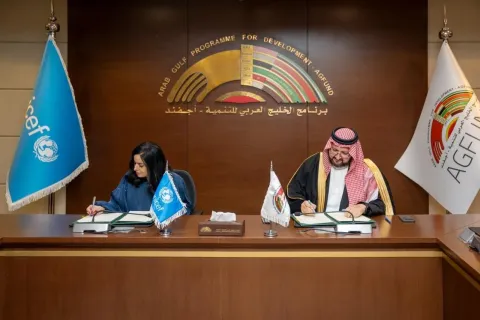
UNICEF, Mohammed bin Rashid Global Initiatives (MBRGI), and Children’s Investment Fund Foundation (CIFF) announced a landmark US$300 million partnership on March 25, 2026, in Dubai. Named “Nutrition for All,” it aims to save millions of children from malnutrition in 40 high-burden countries over five years (2026-2030). Malnutrition kills 3.1 million children yearly—half of all under-5 deaths (UNICEF 2025 data). Stunting affects 149 million kids, wasting 45 million. The partnership targets preventing 10 million stunting cases, treating 20 million wasted children, and averting 1 million deaths via fortified foods, supplements, and community programs.
Funds break down: $150M for frontline interventions like ready-to-use therapeutic food (RUTF); $100M for supply chains in Africa and South Asia; $50M for data tracking and policy advocacy. Priority countries include India (27% stunting rate, NFHS-5), Nigeria, Pakistan, and Ethiopia.
UNICEF Executive Director Catherine Russell said, “This transforms global nutrition security.” MBRGI’s CEO Abdulla Al Mannaie added, “UAE commits to ending hunger by 2030.” CIFF’s Kate Lloyd emphasized evidence-based scaling.
In India, it supports 5 million kids via Anganwadi centers, aligning with Poshan 2.0. Assam benefits with $10M for tea garden children, where 35% are stunted (NFHS-5). Pilots in Bangladesh cut wasting 25% last year.
FAQs [Frequently Asked Questions]
1. What is the goal of the UNICEF-MBRGI-CIFF partnership?
It uses $300M over 5 years to prevent 10M stunting cases, treat 20M wasted kids, and save 1M lives in 40 countries.
2. Which countries and regions will benefit most?
High-burden areas like India (27% stunting), Nigeria, Pakistan, Ethiopia; focuses Africa, South Asia with RUTF and community programs.
3. How does this help India and Assam specifically?
Supports 5M Indian kids via Anganwadis; $10M for Assam’s tea gardens to cut 35% stunting rate (NFHS-5 data).
(*Image Source- UNICEF)