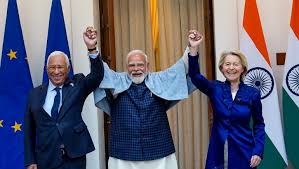
India has finalized a landmark Free Trade Agreement (FTA) with the European Union, hailed by Prime Minister Narendra Modi as the “mother of all deals.” This historic pact, announced on January 27, 2026, during the India-EU Summit, covers a quarter of global GDP and unites 2 billion people in a massive free trade zone.
The agreement eliminates or reduces tariffs on over 96% of EU goods entering India, saving Europe up to €4 billion ($4.75 billion) in duties yearly. India gains duty-free access for 99.5% of its exports to the EU within seven years, boosting sectors like textiles, chemicals, pharmaceuticals, marine products, leather, and gems. Bilateral trade, valued at $136.5 billion in FY 2024-25, could double to $250 billion by 2030, creating jobs and integrating India into global supply chains.
Modi stated the deal offers huge opportunities for India’s 1.4 billion people and EU citizens, calling it a milestone after 20 years of talks. He thanked EU leaders, noting it strengthens ties amid global shifts like “China-plus-one” strategies. Formal signing follows a 5-6 month legal review, with implementation expected within a year.
Indian exporters in labor-intensive areas like apparel and IT services will see 10-15% growth. The FTA emphasizes sustainability, digital trade, IP rights, and professional mobility (Mode 4), aiding “Make in India” and Viksit Bharat 2047. Europe gets easier access to India’s market for machinery, chemicals, and pharma, while India attracts more FDI—already $70 billion in 2023-24.
FAQs [Frequently Asked Questions]
1. When was the India-EU FTA announced?
Prime Minister Modi and EU leaders announced it on January 27, 2026, at the India-EU Summit in New Delhi, after nearly 20 years of negotiations. Formal signing awaits a 5-6 month legal review, with rollout in about a year.
2. What are the main tariff changes?
EU tariffs on 99.5% of Indian goods drop to zero over seven years; India cuts duties on 96.6% of EU imports. This saves EU €4 billion annually and boosts Indian exports in textiles, chemicals, and pharma.
3. Which Indian sectors benefit most?
Textiles, apparel, chemicals, pharmaceuticals, marine products, leather, and gems gain duty-free EU access, spurring 10-15% export growth and jobs. Services like IT and professional mobility also expand under Mode 4 provisions.