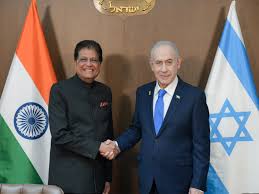
Union Commerce and Industry Minister Piyush Goyal’s recent visit to Israel has given a fresh push to the long-pending India-Israel Free Trade Agreement (FTA), with talks now moving into a structured, time-bound phase. During his three-day visit from 20–22 November 2025, Goyal met Israeli Prime Minister Benjamin Netanyahu and President Isaac Herzog in Jerusalem and Tel Aviv, underscoring New Delhi’s focus on deepening strategic and economic ties with the key West Asian partner.
At the political level, Goyal briefed Netanyahu on the outcomes of meetings with Israel’s Economy and Agriculture ministers and highlighted the strong interest of both governments and businesses in accelerating cooperation. Netanyahu, in turn, reiterated Israel’s support for closer engagement with India in sectors such as defence, innovation, water management and advanced agriculture, areas that already form the backbone of the strategic partnership between the two countries.
A key highlight of the visit was the signing of the “Terms of Reference” (ToR) in Tel Aviv on 20 November, which formally launches negotiations for a comprehensive FTA covering goods, services, investment, digital trade and innovation. The ToR was signed by Piyush Goyal and Israeli Economy and Industry Minister Nir Barkat, and is seen as the first major step after nearly a decade-long pause in earlier FTA efforts that had already gone through eight rounds of talks.
Economically, both sides hope the proposed FTA will unlock new value in a relationship where bilateral trade in goods and services averages around 4.7–6.5 billion US dollars, excluding defence and diamonds. In 2023–24, total India-Israel trade reached about 6.53 billion US dollars, although more recent data for 2024–25 shows merchandise trade at a more modest 3.6 billion US dollars, with Indian exports of roughly 2.1 billion US dollars and imports of about 1.5 billion US dollars.
Officials and analysts say a phased FTA could be adopted, with an initial package focusing on easier wins to deliver early benefits for businesses in both countries. Strategic sectors like high-tech, cybersecurity, precision agriculture, water technologies, defence production, and innovation partnerships are expected to take centre stage, while traditional merchandise trade, though important, may see relatively limited short-term gains. For India, Israel is already the second-largest trading partner in Asia and seventh globally, and nearly 300 Israeli companies are present in the Indian market, highlighting the scope for deeper collaboration once tariff and regulatory barriers start coming down under the FTA framework.
FAQs [Frequently Asked Questions]
-
What is the main outcome of Piyush Goyal’s Israel visit?
The main outcome is the signing of the Terms of Reference to formally start India-Israel FTA negotiations, signalling a serious, time-bound push to deepen trade and investment ties. -
Why is an India-Israel FTA important?
An FTA is important because it can reduce tariffs, simplify regulations and boost cooperation in sectors like technology, defence, agriculture and water, helping both economies grow and diversify. -
How big is India-Israel trade right now?
Bilateral trade (excluding defence and diamonds) has ranged between about 4.7 and 6.5 billion US dollars in recent years, with India generally enjoying a trade surplus with Israel. -
Which sectors may benefit most from the proposed FTA?
Sectors expected to gain include high-tech, cybersecurity, precision agriculture, water technologies, cleantech, medical devices, and services such as innovation partnerships and business services between Indian and Israeli firms.