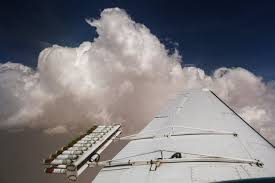
The United Arab Emirates (UAE) faces severe water scarcity, with annual rainfall below 100mm and limited groundwater. To tackle this, the country invests heavily in cloud seeding, a technique to boost rainfall by releasing particles into clouds. This effort is part of a climate change adaptation strategy led by the National Centre of Meteorology (NCM).
Cloud seeding involves flying aircraft into suitable clouds and dispersing salt or silver iodide to encourage rain formation. The UAE uses four Beechcraft King Air C90 planes and 10 pilots, launching missions whenever convective clouds appear. In 2025, the program conducted 185 operations by July and 172 by August, aiming for nearly 300 missions yearly.
Each flight costs about $8,000 per hour, with over 900 hours annually, totaling around $9 million. Despite the expense, cloud seeding produces water cheaper than desalination, the UAE’s main source. Research shows it increases rainfall by 10-25%, adding 84 to 419 million cubic meters of usable water each year.
The UAE Research Program for Rain Enhancement Science (UAEREP) drives innovation, funding $22.5 million in grants for new materials like nanomaterials and AI tools. Advanced radar, satellites, and machine learning help predict and target clouds accurately. This has led to studies estimating a 23% rainfall boost in seeded areas.
Recent heavy rains in July 2025, aided by 39 seeding missions, highlight progress, though flash floods remain a risk. The program also explores drones and lasers for future enhancement. By reducing desalination reliance, cloud seeding supports sustainable water security in this arid nation.
Experts like Alya Al Mazrouei from UAEREP stress its value, saying success is not guaranteed but essential. The UAE’s initiative sets a global example, combining technology and research to combat drought and build resilience.
FAQs [Frequently Asked Questions]
- What is cloud seeding and how does it work in the UAE?
Cloud seeding is a weather modification technique where aircraft release salt or silver iodide into clouds to stimulate rain. In the UAE, pilots fly Beechcraft planes into convective clouds, dispersing particles to enhance precipitation, monitored by radars and AI for optimal timing. - How many cloud seeding operations does the UAE conduct annually?
The UAE performs nearly 300 cloud seeding missions each year, totaling over 900 flight hours. In 2025, it completed 185 by July and 172 by August, with each operation costing about $8,000 per hour and targeting suitable clouds. - What benefits has cloud seeding brought to UAE’s water security?
Cloud seeding boosts rainfall by 10-25%, generating 84-419 million cubic meters of water annually, cheaper than desalination. It reduces drought risks and supports climate adaptation, with a 23% increase in seeded areas, aiding the arid region’s freshwater needs. - What innovations is the UAE exploring for future cloud seeding?
The UAE invests $22.5 million in UAEREP grants for AI-driven forecasting, nanomaterials, and drones. It tests lasers and vertical air currents to improve efficiency, aiming to enhance water supply and global rain enhancement research amid growing scarcity.