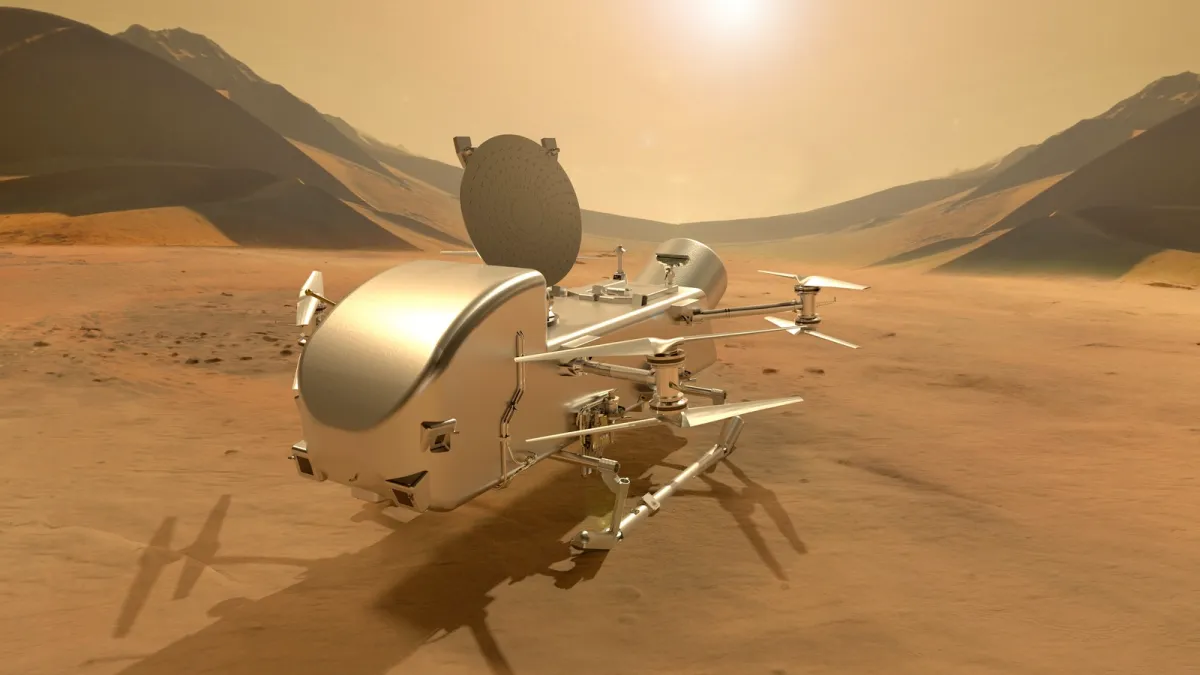
NASA has started building the Dragonfly drone, a nuclear-powered rotorcraft set for launch in 2028 toward Saturn’s moon Titan. This marks a huge step in exploring one of the solar system’s most mysterious worlds. Dragonfly will be the first drone to fly on another planet or moon, powered by a plutonium-based Multi-Mission Radioisotope Thermoelectric Generator (MMRTG). This tech provides steady energy for years without sunlight, unlike solar panels that fail on Titan’s dim, hazy skies.
Titan, larger than Mercury, has a thick nitrogen atmosphere denser than Earth’s. Its surface hides lakes, rivers, and seas of liquid methane and ethane at -179°C (-290°F). Dragonfly will hop between sites, covering up to 8 miles per flight at 10 meters per second. Each stop allows 2-14 days of science: mapping dunes, sampling organics, and hunting prebiotic chemistry that could hint at alien life.
The mission, approved in 2019 with a $850 million budget, builds on Cassini’s 2004-2017 flybys revealing Titan’s Earth-like features. Lockheed Martin leads construction, aiming for a July 2028 launch on a SpaceX Falcon Heavy from Kennedy Space Center. Arrival at Titan is planned for 2034 after a 6.5-year cruise.
This nuclear tech revives NASA’s New Horizons success, where MMRTGs powered the Pluto flyby. Dragonfly’s quadcopter design with four 1-meter rotors beats rovers’ slow pace, scouting 180 km across diverse terrains. It carries a gamma-ray spectrometer, neutron spectrometer, and mass spectrometer for soil analysis.
Experts hail it as a game-changer for astrobiology. “Titan’s organics could rewrite life’s origins,” says NASA’s Dragonfly project scientist Elizabeth Turtle. Challenges include radiation shielding and landing on icy pebbles, but tests mimic Titan’s low gravity (1/7th Earth’s).
FAQs [Frequently Asked Questions]
1. What powers the Dragonfly drone?
Dragonfly uses a plutonium-fueled MMRTG for reliable electricity on Titan’s dark surface, generating heat and power for 14+ years without needing sunlight.
2. When and how will Dragonfly reach Titan?
Launch is July 2028 via SpaceX Falcon Heavy; it arrives in 2034 after a 6.5-year trip, parachuting through Titan’s thick atmosphere to land.
3. What will Dragonfly do on Titan?
It will fly between sites, analyzing organics, mapping dunes, and studying prebiotic chemistry in methane lakes to probe potential life origins.
4. Why choose Titan for this mission?
Titan has Earth-like features: liquid seas, weather, and complex organics in a thick atmosphere, making it ideal for astrobiology research.
(*Image Source- SpaceNews)